On Tuesday evening, I attended the Impact Conference on Policy, Politics and Science, which was hosted by A Global Village. The event opened with a keynote address delivered
by MP Adam Afriyie, who was Shadow Minister for Science and Innovation and is currently
Chair of the Parliamentary Office of Science and Technology (POST). Mr.
Afriyie’s speech revolved around the theme of science and policy, with an
overview of its threats and opportunities. An interesting argument was made on the
scientific approach to policymaking as Mr. Afriyie opined that it could ensure
decisions are made by well-informed politicians who have been provided with
information on the science behind a given issue, and thus prevent decision-makers from creating policies based solely on ideologies. He also touched on the existing innovation gap caused by the
disconnect between research and its application and commercialisation, the
importance of maintaining research funding, and how to make government data
sets freely available for science, business and academic research.
The
event was then followed by multiple workshops on topics ranging from poverty,
climate change, and global health, to innovative technology for development,
cyber-security, leadership and conflict resolution in war-torn countries.
I jumped at the opportunity of attending this event as it addressed international issues that are
related to sustainable development, and the ways in which policymakers, scientists,
and engineers could contribute in making a positive and effective impact on societies
around the world.
The discussions from the event addressed the
importance of information, education, citizen participation, their influence in
political decision-making as well their roles in social and environmental
movements that we have seen in recent times. In addition, the event’s central
theme, which emphasises on the collaboration between policymakers, scientists
and engineers relates to the elements of good governance that indeed calls for the
involvement of all actors that is essential in the concepts of democracy, human
rights, and sustainability. I also found the idea of taking a scientific
approach to policymaking as an interesting notion that could be further
explored.
All in all, the keynote address and the workshops were informative, interactive, and thought-provoking, and the conference certainly exposed participants to discussions on global issues from the political, scientific and
technological dimensions. However, I would have also liked to see a business leader or representative present on the role of the private sector and social enterprises in policymaking, and how they could create that global impact in a way that brings sustainable benefits to the world.
I just read this news article from the New Straits Times on the launching of "green courts" in Malaysia and would like to share it with you. They were established to handle cases related to environmental issues and crimes.
To me, this is exciting development as it shows progress in addressing environmental problems in the country, such as pollution, wildlife trafficking, and illegal logging, and to better enforce national environmental laws and regulations. It is also relevant to the topic of my research, so I'm really interested in seeing how these green courts will play out and the cases that will be tried.
Congratulations! I look forward to following the developments of our newly established "green courts". :)
The recent US presidential race and the re-election of Barack
Obama to a second term brought a sigh of relief for many in the United States and around the world, especially after Mitt Romney’s disturbing jokes on Obama’s plans
to “slow the rise of the oceans” and “heal the planet” that took place at the GOP Convention before Hurricane
Sandy wreaked devastation in New York City. With Obama's return to the White House, activists are continuing to put pressure on him to openly address issues on climate change, clean
energy, and other environmental concerns.
Meanwhile, I have been noticing the development of another hot topic,
which is the bioeconomy. Back in April, the US published its National BioEconomy Blueprint which
according to the White House, has two main purposes – “to lay out
strategic objectives that will help realize the full potential of the U.S.
bioeconomy and to highlight early achievements toward those objectives”.
In Brussels, the European Commission proposed its
Bioeconomy Strategy – Innovating for
Sustainable Growth: a Bioeconomy for Europe, which emphasizes the need for Europe
to transition to a post-petroleum society. Its aim is to “pave the way to a more innovative, resource efficient and competitive
society that reconciles food security with the sustainable use of renewable
resources for industrial purposes, while ensuring environmental protection”.
In China, the country has placed bioeconomy as one of
its key development priorities and in its 12th Five-Year Plan, biotechnology has
been included as one of China’s seven strategic emerging industries.
And in Malaysia, we have what’s called the Bioeconomy
Initiative Malaysia (BIM), which is expected to produce new ideas and methods
of utilizing renewable energy under the support of the National Biotech Policy.
It seems that the world is all abuzz over this
emerging engine of growth and countries are racing to become the global leader
in biotechnology.
So what is the bioeconomy and why is it given so much attention these days?
According to the United Nations Conference on
Sustainable Development’s (UNCSD) Rio +20 event on Bio-economy and Development,
“the functioning of today’s economic
system essentially depends on non-renewable resources, and cannot be therefore
sustained forever, it cannot be eternal…”
There is a steady realization that the conventional model
of unlimited growth cannot be sustainable because it does not take into account
that the energy and natural resources we are currently dependent on are finite.
Continuing to intensely exploit these resources could lead to what is described
as “an alteration of the biological
balances, up to ecologic and economic rejection".
In this regard, the bioeconomy presents an
alternative solution that could harness innovation, contribute to economic
growth and most importantly produce beneficial outcomes for society and the
environment.
Also referred to as the “green economy” or
“biotechonomy”, the bioeconomy has been defined and described in several different
ways. The OECD stated: “From a broad
economic perspective, the bioeconomy refers to the set of economic activities
relating to the invention, development, production and use of biological
products and processes”.
In the US, the emphasis on the bioeconomy is on “harnessing biological research innovations
to meet national challenges in health, food, energy, and the environment”,
whereas in the EU a bioeconomy “encompasses
the production of renewable biological resources and the conversion of these
resources and waste streams into value added products, such as food, feed, bio-based
products and bioenergy”.
The UNCSD explains that “Bio-economy is an environmental and economic theory and practice by
which you can proceed towards a new ecological and social development.” Thus,
it is understood that the basic concept of the bioeconomy is to turn biomass into
marketable goods and services such as biofuels, bioplastics, bioenergy, and so
on. According to
Dato’ Dr Mohd Nazlee Kamal,CEO of the Malaysian Biotechnology Corporation (BiotechCorp), the
biotechnology industry contributes roughly 2.2% towards Malaysia’s GDP and
about $5.4bn in investments for private and public spending. The Chairman of BiotechCorp, Dato’ Dr Zakri Abdul Hamid, explained “instead of an economy
dependent on the planet's limited supply of non-renewable resources such as
petroleum and coal, we could convert plant material, municipal and livestock
waste and biomass into electricity, fuels, plastics and the basic components of
chemical processes”.
However, there are also concerns that have been
raised in the global debate. It has been argued that biomass will presumably be
produced using the techniques of industrial agriculture, which may not
necessarily be biofriendly, and would cause the destruction of biodiversity,
erosion, pollution, deforestation, land-grabbing, and increased GHG emissions. Skepticism were expressed by the Action Group on Erosion, Technology and
Concentration (ETC), in The New Biomassters - Synthetic Biology and The Next Assault on Biodiversity and Livelihoods, as it argues that “what’s behind the dash to biomass is not high ideals but the
calculated interest of the corporate bottom line. Far from changing to a new
economy, the biomass transition describes the retooling of the same old economy
of production, consumption, capital accumulation, and exploitation – only now a
new source of carbon is being plundered to keep the industrial machines going".
The International Food Policy Research Institute (in their paper on Water and Food in the Bio-economy: Challenges and Opportunities for Development) also stated concerns with regard to the impact of the bioeconomy on water and land resources in relation to biofuel production, reporting that "the water
requirement for energy derived from biomass is quite large—about 70 to 400 times greater than
other energy carriers such as fossil fuels, wind and solar (Gerben-Leenes et al. 2008 as quoted in
DeFraiture and Berndes 2009)".
Hence, while it appears that the bioeconomy could contribute to major socio-economic developments, such
as improving health outcomes, boosting the productivity of agriculture and
industrial processes, and enhancing environmental sustainability, harnessing
its potential will require coordinated policy action by governments, collaborative business models for knowledge-sharing, strategic investments in research, active citizen participation, and effective dialogue between all actors involved in the transition. Without proper regulation and implementation, the bioeconomy could bring future risks and further exacerbate social and environmental problems.
The past 2 months have been a total whirlwind for me as I encountered major changes in my life, which have been primarily linked to my academic pursuits. After going through all kinds of application processes, I am happy to announce that I am now pursuing a Ph.D at the Centre for Environmental Policy in Imperial College London!
The Queen's Tower at Imperial College London
I will keep you updated on topics related to my research area on Environmental Governance, and will try my best to write on current sustainability issues whenever I am able to. In the meantime, I intend to make the most out of my study here in London.
With the long and challenging road that now lies ahead of me, I look forward to experiencing the journey of a doctoral researcher and in the process of this endeavour, I do hope to gain some valuable insights and experience that may help me grow personally, academically, and professionally as well.
As the Rector mentioned in his welcoming speech during our first week at IC, in which he quoted Sir Gareth Roberts:
“The product that the PhD researcher creates is not the thesis – vital though that is to their subject area through the creation of original knowledge – no, the product of their study is the development of themselves.”
August
31st, which falls on a Friday this year, marks the day my country
gained its independence from British colonial rule in 1957 (and 1963 for the
states of Sabah & Sarawak). We refer to this important day as “Hari Merdeka”, a day in which we are
reminded of the unforgettable scene that took place 55 years ago at Stadium Merdeka in Kuala Lumpur, where
our first Prime Minister, Tunku Abdul Rahman Putra Al-Haj, proclaimed the country's
independence and shouted out “Merdeka!” seven times as the new flag was raised.
Our first Prime Minister, Tunku Abdul Rahman Putra Al-Haj, at Stadium Merdeka in Kuala Lumpur on 31 August, 1957
Looking
back at the rapid development that Malaysia has undergone over the
years since that historical event, I cannot help but feel proud and grateful
for what we have managed to achieve thus far as a nation. Although I was raised as a “third culture kid”, no matter how far I’ve travelled and wherever
I have lived in this world, Malaysia
has and will always remain close to my heart.
Nonetheless,
as any concerned citizen, I have noticed that there remains certain elements in our eco-system and fabric of our society that has potential to cause
serious and long-term harm.
This
is why through Malaysia’s
transformation agenda and the quest to pursue our development goals towards
Vision 2020 and beyond, it is pertinent for the country to ensure that it is
integrating the three principles of sustainability – people, planet, and profit
– so that in meeting our development needs, we are not compromising the
ability of our future generations to meet theirs.
However, in order to achieve this
balance, not only do we need the Government, but also industry, academia, and
the rakyat (“the people”), whose
active participation are as equally important in spurring the country’s growth
on the national and global level. This “Quadruple Helix” model, which was
adopted as part of Malaysia’s
National Innovation Strategy, reminds us that as members of the rakyat, each of us has great potential
to play a major role in contributing to the sustainable and transformational
development of the country.
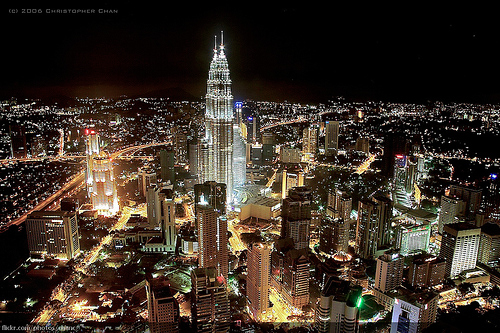
Kuala Lumpur, capital of Malaysia, at night
We
have only one planet and on this planet, we Malaysians have only one Malaysia.
Approaching 55 years of independence, Malaysia has indeed made
significant strides in the course of its golden years but certainly there are
many more improvements to be made.
In this regard, it is crucial for our
leaders and policy-makers to identify and seek solutions to address existing
lacunae in the implementation of national policies and agendas.
Indeed,
I am truly blessed to be an “anak
Merdeka” of this beautiful country of endless possibilities. I hope that we
Malaysians will all make efforts to cooperate and collaborate together in achieving higher
standards of living and development that is socially, economically, and
environmentally sound. In
the words of our Prime Minister, Hon. Dato’ Sri Najib Tun Razak:
“We must continuously strive for
excellence; we cannot and must not compromise and settle for lower standards
and mediocrity. The challenge is for Malaysia to be better than the
best. While we should be proud of what we have achieved, we should not be
complacent as the world continues to move forward with new technologies, ideas
and discoveries. Change is the only constant. There is no escaping this trend
and we must strive to better ourselves and create an even better environment
for future generations.”
Terima kasih Malaysia for always welcoming me home with open arms and a
warm bundle of nasi lemak wrapped in
banana leaf.
I wish my fellow citizens in Malaysia and around the world a
happy independence day - SELAMAT HARI MERDEKA!
Check out the "Malaysia Truly Asia" video below. I grew up with this song :)